New Launchings posts can be found on the Mathematical Association of America’s Math Values blog. This site will remain live as an archive for all previous posts.

Thursday, January 3, 2019

Friday, November 30, 2018
Data Analytics in the Undergraduate Curriculum
By David Bressoud
You can now follow me on Twitter @dbressoud
The National Academies will be holding a Roundtable on Data Science Postsecondary Education: Motivating Data Science Education through Social Good on December 10, 2018. Event Website
You can now follow me on Twitter @dbressoud
The National Academies will be holding a Roundtable on Data Science Postsecondary Education: Motivating Data Science Education through Social Good on December 10, 2018. Event Website
If I had to choose the most common job title for students who have graduated from Macalester with a degree in Mathematics, it would be analyst. Our graduates seldom wind up in jobs where they have to find derivatives or integrals, solve differential equations, or even find eigenvalues. Instead, they are almost always working with and trying to make sense of the data that can inform and shape business decisions. The habits of mind intrinsic to mathematics have generally prepared them for this role. But as the data available to business and industry has exploded in quantity and complexity, there is a growing need for graduates familiar with the increasingly sophisticated tools available for its analysis. The challenge to our colleges and universities is to provide the education that will equip graduates to become the data analysts that we need today and for the future.
 |
| Cover of the National Academies' Report on Data Science for Undergraduates. |
In response to this need, the National Academies have produced a report, Data Science for Undergraduates: Opportunities and Options, that provides a framework for building an undergraduate program in data science. Reflecting the necessarily interdisciplinary nature of such a program, the program is the joint work of the National Research Council’s Computer Science and Telecommunications Board, Board on Mathematical Sciences and Analytics, Committee on Applied and Theoretical Statistics, and Board on Science Education. The official rollout of the report is December 10, 2018 at the roundtable described at the top of this column.
The need is immense. The report references an estimate that by 2020 the U.S. will have positions for 2.7 million data analysts (p. 1-2). Meeting this need is frustrated by many obstacles, not least of which is the fact that few students understand what data science means or entails. Data analysis is also necessarily highly interdisciplinary, requiring new undergraduate programs that draw on expertise in computer science, information science mathematics, and statistics. As the report forcefully states, no single one of these fields adequately covers the core concepts of data science. It can only be taught as an interdisciplinary program. The breadth that is needed is reflected in this passage from the report:
Building on the work of De Veaux et al. (2017), the committee puts forth the following key concept areas for data science: mathematical foundations, computational foundations, statistical foundations, data management and curation, data description and visualization, data modeling and assessment, workflow and reproducibility, communication and teamwork, domain-specific considerations, and ethical problem solving. (p. 2-7)
The report goes into a detailed exploration of the necessary contributions from each of these concept areas.
It also briefly describes programs for majors in data science at the University of Michigan, Smith College, Virginia Tech, UC San Diego, University of Rochester, MIT, UC Irvine, and the NYU School of Professional Studies, programs that are variously housed within a business school, a department of mathematics or statistics, or a computer science department. The report describes a variety of data science minors and highlights the need to provide a basic understanding of data science for all undergraduates.
Macalester College has its own minor in data science. We are particularly well situated for such a program since we have a single department of Mathematics, Statistics, and Computer Science. This is a department that is strong in all three areas and has a long history of cooperation among these disciplines, including several cross-disciplinary faculty hires.
Our data science program begins with Introduction to Data Science, a course on the handling, analysis, and interpretation of big data sets that is intended to be accessible to all students. Students minoring in data science need two computer science courses, which could include our junior-level course in Database Management Systems. They also take Introduction to Statistical Modeling plus a course in Machine Learning, Survival Analysis, or Bayesian Statistics, and two courses in a single domain such as bioinformatics that provide an opportunity for the application of data science methods. A complete description of Macalester’s data science minor can be found at here.
Most math departments lost their faculty who worked in computer science decades ago. Statistics has long been a separate department at many universities. Far too often applied mathematics has been spun off, leaving a department that is increasingly insular, isolated from some of the most important developments in the mathematical sciences today. Separate departments are not necessarily a bad idea provided they are able to work collaboratively and share the work that transcends existing boundaries. If they are to serve their students, today’s departments of mathematics must be engaged in the process of shaping and delivering programs in data science.
References
De Veaux, R., M. Agarwal, M. Averett, B.S. Baumer, A. Bray, T.C. Bressoud, L. Bryant, et al. 2017. Curriculum guidelines for undergraduate programs in data science. Annual Review of Statistics and Its Applications 4:2.1-2.6.
National Academies of Sciences, Engineering, and Medicine. 2018. Data Science for Undergraduates: Opportunities and Options. Washington, DC: The National Academies Press. doi.org/10.17226/25104.
National Academies of Sciences, Engineering, and Medicine. 2018. Roundtable on Data Science Postsecondary Education: Motivating Data Science Education through Social Good. www.eventbrite.com/e/motivating-data-science-education-through-social-good-registration-51307330607
Thursday, November 1, 2018
The Derivative is not the Slope of the Tangent Line
You can now follow me on Twitter @dbressoud
When I teach either the first or second semester of calculus, I always begin with a short problem set to assess student understanding of a few key ideas. One of the first questions I pose is to give the students a simple cubic polynomial, say x3+ 6x, and ask for both the average rate of change over a given interval, say [0,2], and the instantaneous rate of change at a particular value, say x = 1. Invariably, almost everyone, even at the start of Calculus I, can calculate the instantaneous rate of change. Almost no one gives me the correct average rate of change.
The difficulty is that finding the instantaneous rate is formulaic. If students remember nothing else from calculus, they know that differentiation turns x3+ 6x into 3x2 + 6. Asking for the average rate of change requires that they know what this means. I am certain that my students all saw average rates of change in their precalculus courses. They probably saw it again when they were introduced to the derivative in high school calculus. But in a calculus class, it is merely a step in the development of the derivative, a case of what the teacher talks about but not what they need to know for the exam.
The belief that average rates of change are not significant is reinforced when, as in Stewart’s calculus, the derivative is introduced as the slope of the tangent line. The problem is that slope is a problematic concept for many students. Identifying the derivative with the slope of a tangent line suggests a geometric understanding of derivatives. But too often it does no such thing, instead short-circuiting student development of an understanding of the derivative as describing the multiplicative relationship between changes in two linked variables.
The problematic nature of slope and rates of change was nicely documented in a paper by Cameron Byerley and Pat Thompson that appeared last year in the Journal of Mathematical Behavior. In the summers of 2013 and 2014, they administered a diagnostic instrument requiring written responses to 251 high school mathematics teachers.
The following is an example of the kinds of questions that were asked. Part B was asked on a separate page with the answer entered by pen so that teachers could not go back to change the answer to Part A after seeing Part B.
Part A. Mrs. Samber taught an introductory lesson on slope. In the lesson she divided 8.2 by 2.7 to calculate the slope of a line, getting 3.04. Convey to Mrs. Samber’s students what 3.04 means.
Part B. A student explained the meaning of 3.04 by saying, “It means that every time x changes by 1, y changes by 3.04.” Mrs. Samber asked, “What would 3.04 mean if x changes by something other than 1?” What would be a good answer to Mrs. Samber’s question?
The point that Byerley and Thompson were getting at was whether teachers recognized 3.04 as a multiplicative factor connecting the change in x to the change in y. Earlier interviews had revealed that many teachers have a “chunky” understanding of slope, that a slope of ¾ means that if you go 4 units to the right and 3 units up, you will return to the line. One sign of a chunky understanding is an inability to find the increase in y if x changes by something other than 4. Another is the belief that a slope of –5/6 is different from a slope of 5/–6, indicating that the teacher understands a slope of a/b as meaning a sequence of actions rather than a single number.
A chunky explanation of Part A, similar to the student’s response described in Part B, was given by 78% of the teachers. Part B was included to give them a chance to expand to a multiplicative explanation. Only 8% of the teachers who gave a chunky answer to Part A provided a multiplicative response to Part B.
Further teacher difficulties with the concept of slope and rate of change are illustrated in the following two problems (Figures 1 and 2).
 |
Figure 1. Item Called Relative Rates.
© 2014 Arizona Board of Regents. Used with permission.
|
 |
Figure 2. Item Called Slope from Blank Graph.
© 2014 Arizona Board of Regents. Used with permission.
|
Given teacher difficulties with the concept of slope, we should expect most of our students to enter calculus with an inadequate understanding of what it tells us about the relationship between the variables. While mathematicians hear “slope” and associate it with the multiplicative relationship between changes in the two variables, most of our students interpret it as nothing more than an arbitrary numerical description of the degree of “slantiness.”
Consequently, when we define the derivative as the slope of the tangent, we fail to convey the meaning that makes the derivative so useful. If we want students to understand this meaning, the derivative must be introduced in terms of a multiplicative relationship between changes in the variables. It must be grounded in a thorough understanding of what average rates of change tell us and what a constant rate of change actually implies.
Reference
Byerley, C. and Thompson, P. (2017). Secondary mathematics teachers’ meaning for measure, slope, and rate of change. Journal of Mathematical Behavior. 48:168–193.
Monday, October 1, 2018
CBMS Forum Announcement: High School to College Mathematics Pathways
You can now follow me on Twitter @dbressoud
The Forum will focus on three issues with which the professional societies have wrestled and toward which they can contribute insight:
The Forum will be held at the Hyatt Regency, Reston, VA, convenient to both Washington, DC and Dulles airport. It will begin at 5 p.m. on Sunday, May 5 and conclude at 3:30 p.m. on Tuesday, May 7. It will offer a mix of plenary speakers and panelists as well as breakout sessions where participants can receive advice and support from policy experts at the Dana Center and engage with representatives of the CBMS societies around their recent reports and recommendations. Thanks to sponsorship from the Teagle Foundation and expected support from the National Science Foundation and the Carnegie Corporation of New York, CBMS anticipates covering the hotel expenses for up to six team members from up to 25 states.
The day before the Forum, Saturday, May 4, 2019, is the biennial National Math Festival, held at the Washington, DC, Convention Center. Those coming to the Forum are strongly encouraged to take in this day of mathematics for all
Diane Briars, Chair of CBMS, also chairs the planning committee. For questions, please contact Kelly Chapman, CBMS Administrative Coordinator, kchapma1@macalester.edu.
I am using this month’s column to announce the next Forum from the Conference Board of the Mathematical Sciences (CBMS), High School to College Mathematics Pathways: Preparing Students for the Future. It will be held at the Hyatt Regency in Reston, VA, May 5–7, 2019, run in cooperation with the Charles A. Dana Center at the University of Texas, Austin and Achieve. Details can be found here.
The Forum is designed to develop and support state-based task forces working to bridge the gaps between high school and college mathematics. The ultimate goal is to help states create policies and practices for mathematics instruction that contribute to successful completion without reducing quality. To be truly effective, such a task force will need to be representative of all interests across the state including business and industry as well as those who shape educational policy and those who implement it at both high school and post-secondary levels, including both two- and four-year institutions. The full task force will probably have twenty or more members. The Forum is intended to work with a smaller team of six to eight individuals who will provide the leadership for the task force.
 |
Figure 1. Bill McCallum, Brit Kirwan, and Joan Leitzel at the Third CBMS Forum, Content-Based Professional Development for Teachers of Mathematics, October 10-12, 2010
|
 |
| Figure 2. One of the breakout sessions from the Third CBMS Forum. |
The Forum will focus on three issues with which the professional societies have wrestled and toward which they can contribute insight:
- Responding to the changing role of mathematics in the economy. The avalanche of data across all fields is spurring exciting and important work in mathematics. The transition years of grades 11–14 are critical for building the foundations for a workforce that can meet the evolving needs of the new economy.
- Ensuring college readiness today and tomorrow. High school and college mathematics educators are working collaboratively on this issue, recognizing the need for college-ready students, but also student-ready colleges. CBMS societies acknowledge the need for a broader understanding of how mathematics is and will be used, encompassing modeling, statistics, and data science. They also understand the need for active learning approaches that promote problem-solving abilities and higher order thinking.
- Articulating the mathematical pathways that will serve all students. Changes in demographics, economic demands, and the mathematical sciences themselves are forcing reconsideration of the pathways into and through college-level mathematics. It is necessary to evaluate whether the course structures now in place still serve their intended purpose and to understand the alternatives that are available.
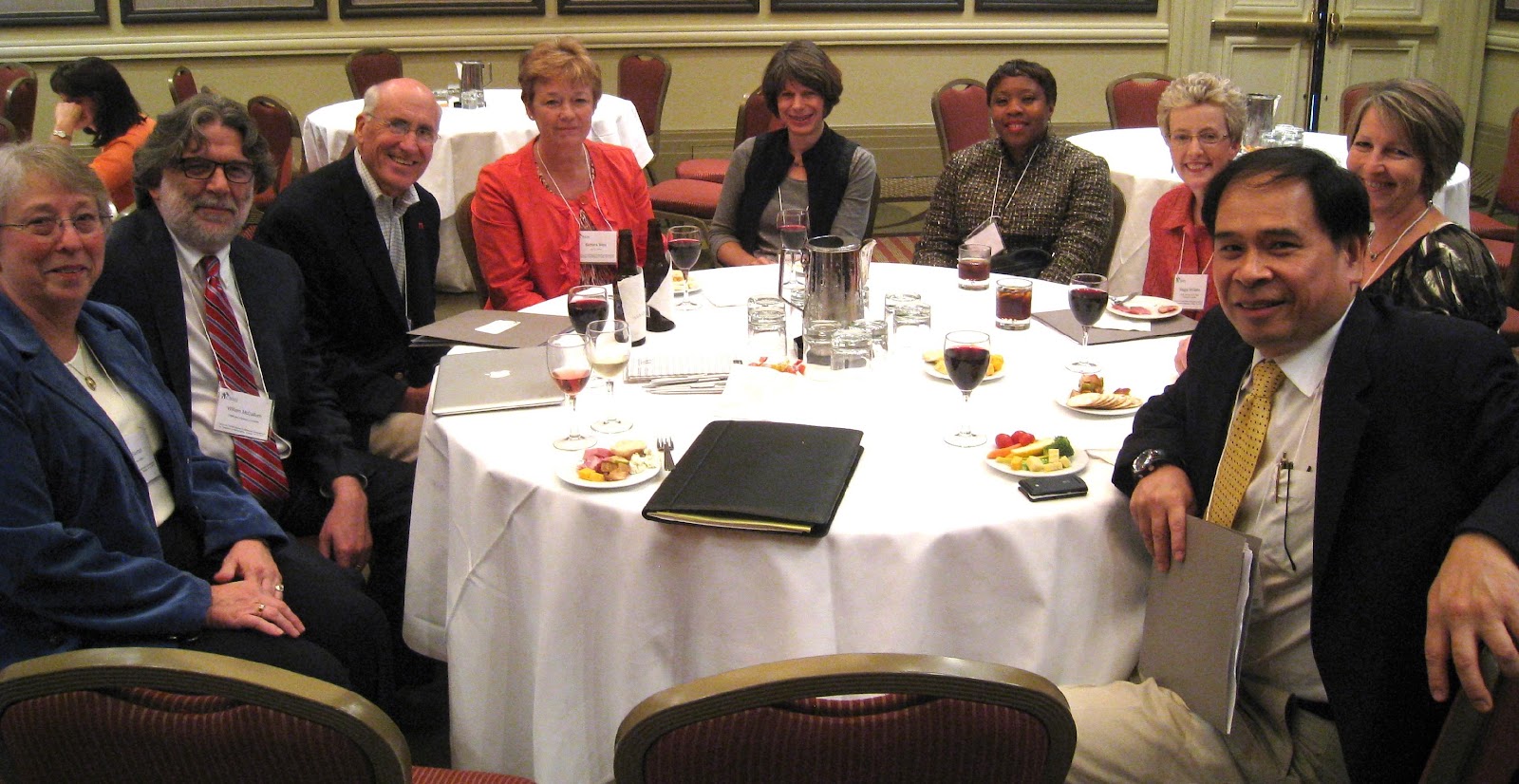 |
| Figure 3. Following lunch discussion at Third CBMS Forum. |
Structure of the ForumFi
The spring 2019 Forum will be built around 20 to 25 state-based teams of six to eight leaders who are committed to the formation of a local task force that will pursue dialogue leading to the creation of structures and policies that address the three issues. Each team should include representatives of the state’s department of education, higher education system, and two-year college system, while also drawing on state leaders who have been engaged in efforts to improve mathematics education at either the high school or college level. In addition to its plenary sessions, the Forum will be offering breakout sessions designed to meet the needs of state leaders at four different stages of development of bridging activities:
The spring 2019 Forum will be built around 20 to 25 state-based teams of six to eight leaders who are committed to the formation of a local task force that will pursue dialogue leading to the creation of structures and policies that address the three issues. Each team should include representatives of the state’s department of education, higher education system, and two-year college system, while also drawing on state leaders who have been engaged in efforts to improve mathematics education at either the high school or college level. In addition to its plenary sessions, the Forum will be offering breakout sessions designed to meet the needs of state leaders at four different stages of development of bridging activities:
- Investigating. At the introductory level are those state-based leaders who are simply curious about what has been happening in mathematics education focused on grades 11 to 14. The Forum will expose them to a wealth of information and offer suggestions of how they could begin to address the issues of the mathematical bridge.
- Initializing. These are state-based teams that are aware of significant problems at the transition from high school to college mathematics, are ready to start looking at programs and efforts that could improve the situation, and want to learn more about the options that are available and the efforts being undertaken in other states.
- Emerging. These are the states that have begun work on one side of the problem but have not started to coordinate efforts across the gap. The Forum will provide networking opportunities with states that are well down the road of coordinating these efforts.
- Implementing. These are the states that are committed to efforts that regularly bring together leaders from K-12 and higher education and are in the process of developing coordinated programs. We will provide opportunities for them to learn of other efforts and to work with policy experts to deal with obstacles and difficulties that have been encountered.
The state-based teams will leave the Forum with an agenda for following up on the ideas that they have encountered and with the connections necessary to help them as they flesh out the construction of a task force to address issues at the transition from high school to college mathematics. There will be continuing support from the Dana Center and the opportunity to engage more directly with their expertise in policy formation.
The Forum will be held at the Hyatt Regency, Reston, VA, convenient to both Washington, DC and Dulles airport. It will begin at 5 p.m. on Sunday, May 5 and conclude at 3:30 p.m. on Tuesday, May 7. It will offer a mix of plenary speakers and panelists as well as breakout sessions where participants can receive advice and support from policy experts at the Dana Center and engage with representatives of the CBMS societies around their recent reports and recommendations. Thanks to sponsorship from the Teagle Foundation and expected support from the National Science Foundation and the Carnegie Corporation of New York, CBMS anticipates covering the hotel expenses for up to six team members from up to 25 states.
The day before the Forum, Saturday, May 4, 2019, is the biennial National Math Festival, held at the Washington, DC, Convention Center. Those coming to the Forum are strongly encouraged to take in this day of mathematics for all
Diane Briars, Chair of CBMS, also chairs the planning committee. For questions, please contact Kelly Chapman, CBMS Administrative Coordinator, kchapma1@macalester.edu.
Friday, August 31, 2018
Should Students Wait until College to Take Calculus?
By David Bressoud
You can now follow me on Twitter @dbressoud
I have often cited data from the Sadler and Sonnert FICSMath study (Factors Influencing College Success in Mathematics, sponsored by NSF grant #0813702), a large-scale study of 10,437 students in mainstream Calculus I in the fall of 2009 at a stratified random sample of 134 U.S. colleges and universities. Sadler and Sonnert have just published their insights from this study into the following question: Are the students who will enroll in Calculus I in college well-served by studying it first in high school?
 |
Figure 1. Phil Sadler (left) and Gerhard Sonnert.
|
To allay the suspense, their answer is a qualified “yes.” Sadler and Sonnert demonstrate that, for most students, having taken any kind of calculus in high school raises college calculus performance by about half a grade. However, they also found that the level of mastery of the high school mathematics considered preparatory for calculus varies widely. It is a far more powerful predictor of how well students will do than whether or not they have seen calculus before.
The FICSMath study had a very simple design. Questionnaires were answered in class, exploring a wide range of variables that might influence student performance in Calculus I. These included race and gender, year in which Algebra I was taken, year in college, college precalculus (if taken), career interest, parental education, high school calculus (if taken), preparation for calculus including courses taken, grades received, and SAT or ACT scores. The single dependent variable was the grade received for the course. The authors employed a hierarchical linear model. They found that about 18% of the variation in grades could be explained at the institution or instructor level. Their model enabled them to focus just on the student effect.
By far the biggest effect at the student level came from preparation for calculus. Figure 2 shows the relationship between grades earned in college calculus and grades earned in high school mathematics courses or on SAT or ACT quantitative exams. The average grade across the entire study was 80.7%, a low B–. We see that less than an A on any high school math course and less than 600 on the SAT or 26 on the ACT suggests a grade of C or less, on average, in college Calculus I. While C is a passing grade, it is a strong signal that there is considerable risk in continuing the pursuit of calculus.
 |
Figure 2. Relationship between grade earned in college calculus and course grade or SAT/ACT score. The symbol area is proportional to the number of students in each group. The dotted line represents the mean grade (80.7) Source: Sadler and Sonnert, 2018, page 312.
|
The six variables indicating various aspects of mathematics preparation were combined into a “Calculus Preparation Composite Score” that was very highly correlated with the probability of taking calculus in high school (Figure 3).
 |
Figure 3. Relationship between calculus preparation composite and probability of taking high school calculus. Source: Sadler and Sonnert 2018, page 313.
|
This demonstrates the difficulty of untangling preparation for calculus from whether a student took calculus in high school. With the calculus preparation composite normalized to a mean of 0 and a standard deviation of 1, the authors found that at every level of preparation, taking calculus in high school led to an improvement in the college calculus grade (Figure 4). For students in their first year of college with an average level of preparation, the boost is 5 points, or half a grade. Intriguingly, the benefit is greatest for the students with the weakest preparation. The benefit is less for students who enroll in Calculus I after their first year in college.
 |
Figure 4. Relationship between college calculus performance, high school preparation, taking high school calculus, and year taking calculus in college.
|
In the introduction to their paper, the authors discuss how the debate over the place of calculus in high school echoes a much older and more fundamental disagreement over the extent to which mathematics is hierarchical. Does every mathematical topic have a set of prerequisites that must be mastered before any progress can be made, or can students benefit from a spiraling effect, introducing new concepts while revisiting the mathematics on which they rest?
From my experience, most mathematicians and mathematics educators recognize that spiraling is an essential part of learning. It is commonplace to assert that one never learns a subject until one has moved on to the course that builds upon it. At the same time, they acknowledge that students whose foundational knowledge is too weak will struggle as they move forward. The familiar adage is that a student does not fail calculus because they do not understand the calculus but because they have not mastered precalculus.
To the college instructor who sees students missing exam questions because of mistakes at the level of precalculus or earlier, the rapid expansion of calculus into our high schools seems a misplaced allocation of resources. And yet, requirements of prerequisite knowledge before admission to calculus that are too strict can limit access to mathematically intensive careers, especially for first generation students and those from under-resourced schools. This is compounded by the fact that, generally speaking, we do a miserable job of remediation. I documented this in “First, Do No Harm.” In this paper, Sadler and Sonnert reveal that—with other variables controlled—taking precalculus in college lowered the Calculus I grade by a small but statistically significant amount, an observation described in greater detail in Sonnert & Sadler, 2014.
We must expect that students will enter Calculus I with deficiencies that will need to be recognized and addressed within the context of the new material in this course. The rapid expansion of courses that offer expanded labs, stretched out curricula, or co-curricular offerings designed to address these deficiencies speak to the growing recognition that this is the case. What we can and should expect by way of preparation for college calculus will need to be institutionally specific, dependent on the goals of the course, the implemented curriculum, the nature of the student body, and a continuing data-based appraisal of how well current support structures and curricula are serving our students.
References
Sadler,
P. & Sonnert, G. (2018). The path to college calculus: the impact of high
school mathematics coursework. Journal
for Research in Mathematics Education. 49(3), 292–329.
Sonnert,
G. & Sadler, P.M. (2014). The impact of taking a college pre-calculus
course on students’ college calculus performance. International Journal of Mathematical Education in Science and
Technology, 45(8), 1188–1207.
Wednesday, August 1, 2018
Calculus as a Modeling Course at Macalester College
By David Bressoud
You can now follow me on Twitter @dbressoud
When I talk with individuals who are wrestling with improving their calculus program, I often describe calculus at Macalester. For over 15 years, we have approached the first calculus course as a modeling course, drawing inspiration from many of the early calculus reform efforts. This month’s column will look at how we came to revise Calculus I in this way, a sample of the curriculum, and thoughts on implementation.
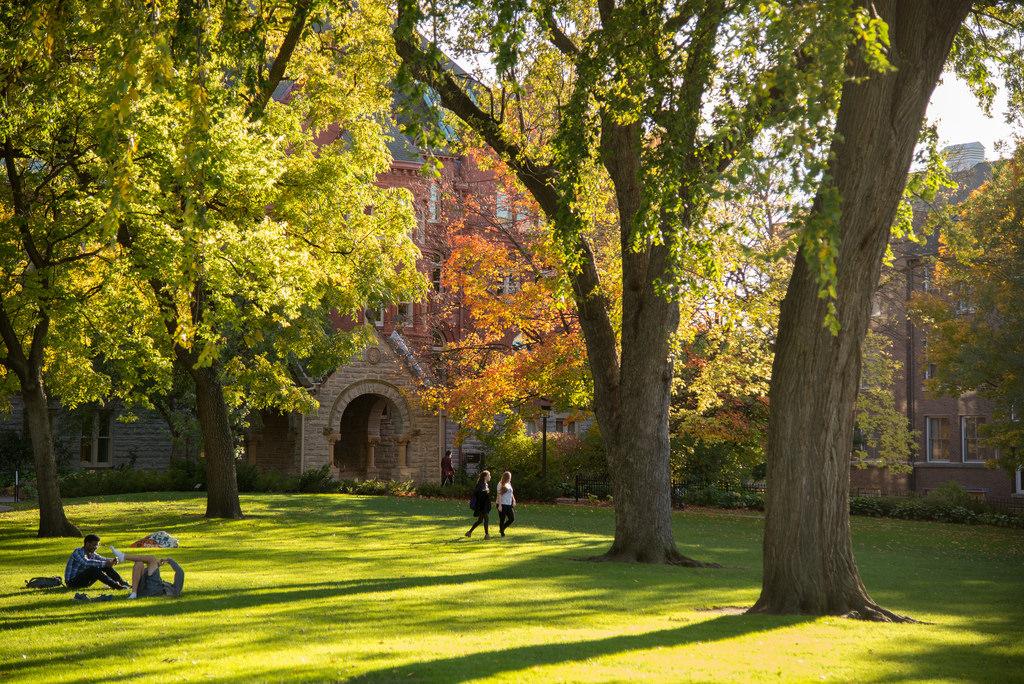 |
Old Main lawn. Macalester College
|
The revision of Calculus I began when Professor Kaplan, then a faculty member whose research was in mathematical models of biological phenomena, looked at transcripts of students who had passed through Calculus I and II. He discovered that, although this is framed as a full-year course, few students took it as such. As was true then and still holds true, the bulk of Calculus I enrollments come from Biology and Economics majors for whom only Calculus I is required and usually only Calculus I is taken. But the traditional Calculus I does not make sense as a stand-alone course. Most of these students were learning how to find derivatives with little sense of why they were doing it. Calculus II enrollments were predominantly prospective mathematics, physics, and chemistry majors as well as the strongest economics majors. Even fifteen years ago, almost all of these students arrived at Macalester having already earned credit for Calculus I. Rather than a course that picked up two-thirds of the way through a course they had already completed, what they needed was a more intensive understanding of both differential and integral calculus.
With financial support from the administration, Kaplan began to shape the introductory courses that our biology majors most needed, a Calculus I with a focus on modeling that could stand on its own, to be followed by a statistics course that emphasized statistical modeling. The sequence that resulted has been described in "The First Year of Calculus and Statistics at Macalester College" (Flath et al, 2013) in the MAA Notes volume that I reviewed in Mathematics for the Biological Sciences (February, 2014).
We are a small college and cannot afford to offer more than one flavor of calculus. Kaplan arranged for the funding to include team-teaching these courses during the first two developmental years. This involved a large fraction of our departmental faculty in shaping these courses, ensuring both a great deal of useful feedback and a strong buy-in to Kaplan’s vision. Major efforts of outreach and explanation with the partner disciplines that required calculus eventually brought them all on board, either enthusiastically as in the case of biology and economics, or reluctantly as with physics. When the time came to decide whether we would embrace this as our only Calculus I course, the department unanimously supported it.
Curriculum
Curriculum
I last taught Calculus I as a modeling course in fall, 2015. Over the years, this course has been subject to continual monitoring and adjustment. What I describe here is simply a snapshot of one moment in an evolving process, but the goals and essential elements of the course have not changed. We want students to finish the course with an appreciation for calculus as a tool for modeling dynamical systems, which means an emphasis throughout on differential equations. In addition, the most interesting and instructive dynamical systems are multi-dimensional, including SIR and predator-prey models. The course employs functions of several variables from the start. Finally, the emphasis is on numerical and qualitative analysis of these models. The procedures of differentiation and integration get less attention that in a traditional course.
No existing textbook fits the course we have built, but we used Hughes-Hallett et al. Applied Calculus (HH). In 2015, there were seven major sections to the course, described below, with indications of the relevant sections of the 5th edition. To anyone who has access to Moodle and wishes the full syllabus and supplementary materials, I can send the Moodle backup for this course.
- Functions as Models. (6 days, HH 1.1–1.3, 1.5–1.7, 1.9–1.10, 8.1–8.2, and supplemental materials). In one sense this was a review of the functions that students should be familiar with from high school: linear, power, exponential, logarithmic, and trigonometric functions, as well as functions of two variables. But the emphasis was on the phenomena that are modeled by each of these types of functions. For exponential and logarithmic functions, attention was paid to the relationship with doubling times. For trigonometric functions, we focused on how to translate knowledge of the range and period of a periodic phenomenon into the formulation of the corresponding sine or cosine. This is also when we introduced students to the software they would be using, in our case R-Studio (chosen so that they could use the same software for the statistical modeling course).
- Units, Dimensions, and Estimation. (3 days, supplemental materials) This is a unit that focuses on key quantitative skills that all college graduates, especially those in quantitative fields, should possess, but are never explicitly taught: understanding scale, the effect of powers of ten, how dimension affects scale, dimensional analysis as a short-cut to finding and remembering formulas, and the kind of estimation found in Fermi problems.
- Concepts of Derivatives. (4 days, HH 2.1–2.3, 8.3, and supplemental materials) We avoid a formal definition of the derivative in terms of limits and instead focus on what is happening to the average rate of change as the time intervals get shorter. As soon as we have explained the concept of the derivative, we extend it to partial and directional derivatives of functions of two variables.
- Symbolic Differentiation. (5 days, HH 3.1–3.5, 8.3–8.4, and supplemental materials) This is a fairly traditional treatment of derivatives. Topics include derivatives of polynomials as well as exponential, logarithmic, and trigonometric functions, and the product, quotient, and chain rules. We spend one of these days fitting data to various kinds of models.
- Optimization. (5 days, HH 4.1–4.3, 8.5–8.6, and supplemental materials) This section starts with traditional optimization techniques and problems, but then moves on to optimizing functions of two variables and constrained optimization problems for functions of two variables, including a very geometric explanation of Lagrange multipliers.
- Integration and Accumulation. (7 days, HH 5.1–5.5, 6.1, 6.3, and supplemental materials) This starts with integration as accumulation, leading up to the Fundamental Theorem of Integral Calculus, 2 days of antidifferentiation as a tool for evaluating definite integrals, followed by a one-day introduction to integrals of functions of two variables.
- Models of Change. (7 days, HH 10.1–10.7 and supplemental materials) This proceeds from a basic introduction to differential equations, through slope fields as means of visualizing solutions, exponential growth and decay, the SIR model, and predator-prey models, ending with a discussion of stability and equilibria.
Thoughts on Implementation
This variation on Calculus I will not work everywhere. It is difficult because there is no textbook that is a good fit, and we have found that faculty teaching it for the first time need a good deal of support. It also does not articulate well with the standard calculus curriculum. At Macalester, with very few students transferring in or out, this is not a problem, but it would be at public universities.
The change in Calculus I also forced major changes to Calculus II. Eventually, Macalester redesigned the entire Calculus I through III sequence to fit this image of calculus as a modeling course with single variable and multivariable functions handled simultaneously. We now call this sequence Applied Multivariable Calculus I, II, and III. This is scary for the student who thinks of multivariable calculus as the course that follows two semesters of single variable calculus, but the title provides an accurate description.
The sequence works very well for us. Learning why calculus is useful has attracted many students into further courses. It has also led to beefing up our upper division applied mathematics and statistics options. This past spring, we graduated 54 majors in mathematics or applied mathematics and statistics out of a graduating class of about 500. Next year, we expect at least 60 majors in mathematics or applied mathematics and statistics. It definitely is working for us.
Nothing communicates what is valued in a course better than how student success is assessed. For that reason, I am concluding this article with links to the exams I administered in 2015. Midterms 1 and 2 were given in class. The final exam was a take-home. In addition, students were graded on WeBWorK problems, more challenging weekly problems that required careful write-up, and Reading Reflections submitted the night before each class to ensure that students had read the relevant material before class.
- Midterm I, based on sections 1, 2, and 3
- Midterm II, based on sections 4, 5, and 6
- Final Exam, comprehensive, but emphasis on section 7
Reference
Flath, D., Halverson, T., Kaplan, D. and Saxe, K. 2013. The first year of calculus and statistics at Macalester College. pp. 39–44 in Undergraduate Mathematics for the Life Sciences: Models, Processes, and Direction. Ledder, Carpenter, and Comar, eds. MAA Notes #81. Washington, DC: Mathematical Association of America. www.maa.org/publications/ebooks/undergraduate-mathematics-for-the-life-sciences
Saturday, June 30, 2018
Departmental Turnaround: The Case of San Diego State University
By David Bressoud
You can now follow me on Twitter @dbressoud
Paul Zorn and I have just published a special issue of PRIMUS on Improving the Teaching and Learning of Calculus (Bressoud & Zorn, 2018) . It contains eight articles that should be of interest to anyone who is discontented with the current state of calculus instruction at their institution. Four of these articles present case studies of universities that have made significant changes within the past few years: San Diego State University (SDSU), the University of Illinois-Chicago, Colorado State University, and the University of Hartford. The most extensive revamping occurred at San Diego State University, which is where I am focusing below.
MAA’s national study of calculus instruction, Characteristics of Successful Programs in College Calculus (CSPCC) , identified seven practices (Bressoud & Rasmussen, 2015; see the Appendix for descriptions) that we observed in the most effective programs. A few years ago, San Diego State University, facing unacceptably high failure rates and low persistence rates in its Precalculus through Calculus II sequence, decided to work on all seven areas. The result has been a dramatic improvement in these courses. Naneh Apkarian, who was a doctoral student in mathematics education within the mathematics department during this process, is the lead author on this account (Apkarian et al., 2018) .

With roughly 30,000 undergraduates, San Diego State University is a large public university, part of the California State University System, and chronically underfunded. It is a Hispanic-Serving Institution where 84% of students are on some form of financial aid. Science, technology, engineering, and mathematics (STEM) majors account for 10% of bachelor’s degrees. The mainstream precalculus and single variable calculus courses enroll about 1,500 students each fall. The Department of Mathematics and Statistics consists of 17 faculty in pure and applied mathematics, seven in statistics, and six in mathematics education.
Michael O’Sullivan was appointed chair of the department in 2014. He made it his mission to revamp lower-division mathematics instruction. The effort began that fall with the creation of a Calculus Task Force charged with proposing a system for coordinating the courses in the Precalculus to Calculus II sequence (P2C2). As Rasmussen and Ellis (2015) have documented, one of the most important characteristics of successful P2C2 programs is coordination of the essential elements of each course including policies, learning objectives, and exams and their scoring rubrics. Coordination also involves regular communication among those teaching different sections. At San Diego State University, total autonomy—to the point where different instructors were using different textbooks, homework systems, and even course content—had been the rule.
As the department expanded its data collection beyond simple pass rates, they discovered that only 17% of those who began with Precalculus successfully completed Calculus II, only 10% within the standard three semesters. This made mathematics faculty aware that something was seriously wrong and needed to change.
Because the discontinuation of large lectures was not financially feasible, the implementation of active learning to address this completion rate was concentrated in breakout sections led by Graduate Teaching Assistants (GTAs). The chair successfully lobbied to increase breakout sections from one to two hours per week and managed to reduce the size of most of these sections.
The chair also tied into a university initiative, Building on Excellence, to fund a new Mathematics Learning Center within the library building, directed by the office of the Dean of Science—ensuring its continued funding—but led by the department. The static 40-question placement exam was replaced by ALEKS Placement, Preparation, and Learning, with the license paid by the California State University System and student payments of $20 per proctored exam.
While these contributions were serendipitous, I have found that—particularly in situations of tightly constrained budgets—deans and provosts are keen to direct resources toward strategic initiatives with the potential for high impact. I have frequently encountered deans who asserted that if only the department would come forward with a well-thought-out and cost-effective plan for improving student outcomes, the money could be found to fund it.
As the authors reported, the effort at revision was successful because of the attention paid to opening and maintaining communication channels with stakeholders in this process (see Figure 2).

Figure 2: Significant communication channels between the mathematics department and various administrative programs as they relate to the seven targeted program features. Source: Apkarian et al. 2018, p. 540.
The result is a calculus program of which the department is justly proud, as reflected in this video. Students find the new Math Learning Center particularly helpful because its work is tightly connected to what is happening in all sections of each course.
The Department of Mathematics and Statistics at San Diego State University is a good example of how a program can be transformed. Its story illustrates the role of leadership from the department chair, buy-in and effort from a core of committed faculty, and strong two-way communication with all of the stakeholders.
References
Appendix: Seven Characteristics of Successful Programs in College Calculus
You can now follow me on Twitter @dbressoud
Paul Zorn and I have just published a special issue of PRIMUS on Improving the Teaching and Learning of Calculus (Bressoud & Zorn, 2018) . It contains eight articles that should be of interest to anyone who is discontented with the current state of calculus instruction at their institution. Four of these articles present case studies of universities that have made significant changes within the past few years: San Diego State University (SDSU), the University of Illinois-Chicago, Colorado State University, and the University of Hartford. The most extensive revamping occurred at San Diego State University, which is where I am focusing below.
MAA’s national study of calculus instruction, Characteristics of Successful Programs in College Calculus (CSPCC) , identified seven practices (Bressoud & Rasmussen, 2015; see the Appendix for descriptions) that we observed in the most effective programs. A few years ago, San Diego State University, facing unacceptably high failure rates and low persistence rates in its Precalculus through Calculus II sequence, decided to work on all seven areas. The result has been a dramatic improvement in these courses. Naneh Apkarian, who was a doctoral student in mathematics education within the mathematics department during this process, is the lead author on this account (Apkarian et al., 2018) .
With roughly 30,000 undergraduates, San Diego State University is a large public university, part of the California State University System, and chronically underfunded. It is a Hispanic-Serving Institution where 84% of students are on some form of financial aid. Science, technology, engineering, and mathematics (STEM) majors account for 10% of bachelor’s degrees. The mainstream precalculus and single variable calculus courses enroll about 1,500 students each fall. The Department of Mathematics and Statistics consists of 17 faculty in pure and applied mathematics, seven in statistics, and six in mathematics education.
Michael O’Sullivan was appointed chair of the department in 2014. He made it his mission to revamp lower-division mathematics instruction. The effort began that fall with the creation of a Calculus Task Force charged with proposing a system for coordinating the courses in the Precalculus to Calculus II sequence (P2C2). As Rasmussen and Ellis (2015) have documented, one of the most important characteristics of successful P2C2 programs is coordination of the essential elements of each course including policies, learning objectives, and exams and their scoring rubrics. Coordination also involves regular communication among those teaching different sections. At San Diego State University, total autonomy—to the point where different instructors were using different textbooks, homework systems, and even course content—had been the rule.
As the department expanded its data collection beyond simple pass rates, they discovered that only 17% of those who began with Precalculus successfully completed Calculus II, only 10% within the standard three semesters. This made mathematics faculty aware that something was seriously wrong and needed to change.
Because the discontinuation of large lectures was not financially feasible, the implementation of active learning to address this completion rate was concentrated in breakout sections led by Graduate Teaching Assistants (GTAs). The chair successfully lobbied to increase breakout sections from one to two hours per week and managed to reduce the size of most of these sections.
The chair also tied into a university initiative, Building on Excellence, to fund a new Mathematics Learning Center within the library building, directed by the office of the Dean of Science—ensuring its continued funding—but led by the department. The static 40-question placement exam was replaced by ALEKS Placement, Preparation, and Learning, with the license paid by the California State University System and student payments of $20 per proctored exam.
While these contributions were serendipitous, I have found that—particularly in situations of tightly constrained budgets—deans and provosts are keen to direct resources toward strategic initiatives with the potential for high impact. I have frequently encountered deans who asserted that if only the department would come forward with a well-thought-out and cost-effective plan for improving student outcomes, the money could be found to fund it.
As the authors reported, the effort at revision was successful because of the attention paid to opening and maintaining communication channels with stakeholders in this process (see Figure 2).
Figure 2: Significant communication channels between the mathematics department and various administrative programs as they relate to the seven targeted program features. Source: Apkarian et al. 2018, p. 540.
The result is a calculus program of which the department is justly proud, as reflected in this video. Students find the new Math Learning Center particularly helpful because its work is tightly connected to what is happening in all sections of each course.
The Department of Mathematics and Statistics at San Diego State University is a good example of how a program can be transformed. Its story illustrates the role of leadership from the department chair, buy-in and effort from a core of committed faculty, and strong two-way communication with all of the stakeholders.
References
- Apkarian, N., Bowers, J., O’Sullivan, M., and Rasmussen, C. (2018). A Case study of change in the teaching and learning of Precalculus to Calculus 2: what we are doing with what we have. PRIMUS. 28:6, 528-549, DOI: 10.1080/10511970.2017.1388319
- Bressoud, D., and Rasmussen, C. (2015). Seven characteristics of successful calculus programs. AMS Notices. 62:2, 144–146.
- Bressoud, D. and Zorn, P. (2018). Improving the Teaching and Learning of Calculus. PRIMUS vol. 28.
- Rasmussen, C., and Ellis, J. (2015). Calculus coordination at PhD-granting universities: more than just using the same syllabus, textbook, and final exam. In Bressoud, Mesa, and Rasmussen (Eds.), Insight and Recommendations from the MAA National Study of College Calculus. MAA Notes #84. Washington, DC: MAA Press.
Appendix: Seven Characteristics of Successful Programs in College Calculus
- Local Data. Regular collection and use of local data to guide program modifications as part of continual improvement efforts.
- Placement. Effective procedures for placing students appropriately into their first Precalculus to Calculus II (P2C2) course (both initial placement and re-placing students after the term begins).
- Coordination System. A coordination system for instruction that (i) makes use of a uniform textbook and assessments and (ii) goes beyond uniform curricular elements to include regular P2C2 instructor meetings in development of de facto communities of practice.
- Course Content. Course content that challenges and engages students with mathematics.
- Active Pedagogy. The use and support of student-centered pedagogies, including active learning strategies.
- GTA Preparation & Development. Robust teaching development programs for teaching assistants.
- Student Support Service. Proactive student support services (e.g., tutoring centers, services for first-generation students) that foster students’ academic and social integration
Subscribe to:
Posts (Atom)